Showing posts with label Environment. Show all posts

Wednesday, April 29, 2026

Mocktails & A Beach Clean-Up!


Bundled up the dog and went to Pasir Ris Beach to join Ocean Purpose Project (OPP) for the morning for their reception to mark the closing of Singapore Maritime Week. 

Ocean Purpose Project is a lot more than just doing beach clean-ups and planting TCM and Ayurvedic herbs in its eco-garden. The chillies and bittergourd and all are happily flourishing. I'm so glad they've got this little plot of land allocated by our National Parks Board (NParks). 

It was a good turn-out. We did a short 20-minute beach clean-up. We've done countless beach clean-ups, which literally means bending over to pick up litter brought in by the currents. It's a never-ending job because our oceans are soooo polluted.

I gotta admit I didn't really pick up litter. I had to hang on to Choya. It isn't conducive for her to be walking in all that litter and sharp bits, or hot sand. I had to make sure she didn't get heatstroke. I delegated the husband to do my part. The dog was in charge of supervising the humans, looking cute, and I was just her minder. Heh. 

Choya was soooo pleased to be rolling around and sniffing all these new-to-her and new-old smells. She identifies places by smells, so when this is a spot that she doesn't come often, she goes crazy. She also loves the beach. She totally enjoyed chilling out with us in this manner. 

But OMG, Choya's licking. Grrrrr. Clostridium strains are heavy in decaying leaves and marine sediments. I had to clean her up thoroughly, but I was still frightened by the idea of her mushy poop for the next two days. (It wasn't too bad. It was foul-smelling; some clostridium spores activated, but very manageable.)

After the hot-hot-hot bits, we retreated to OPP's little hangout. There were house-made pesto with bread. NOMS. The pesto was super garlicky. Loved it. Went well with small bites of bread. I loved the mojitos that they served up. The sea grapes were sooooo cool. (It is an algae.) I loved that salty tang. It was a mocktail, to be specific. This was at 11.30am. Too early for alcohol. The mocktails were "crafted with seaweed, sea grapes, and herbs grown using our own seaweed fertiliser — part of Singapore’s first seaweed blue carbon sequestration site under UN Ocean Action (Project Tanah Air)".

It was also meant to be a networking thing. You know me. I left it to the husband to do so; he returned with a big bag of garbage, as much weight as it could hold. I watched the dog, and chilled. After all, I would be networking next week at a conference, and I would have no choice but to be social. So that would be sufficient for me. 

Monday, September 15, 2025

Thinking About the Fish We Consume


Had to have a read of Editor Khoo Bee Khim’s piece titled, ‘Craving otah or sliced fish soup? Your fish choices could save or harm the sea’, published in CNA Digital on12 September, 2025.

The writer spoke with Pasarfish SG, a local initiative that researches, and imparts knowledge on heritage seafood and sustainable consumption. Pasarfish delves into the types of fish available in our wet markets, and collects data on how the different types of fish have been procured from the fishing boats. Apparently we have more 250 types of fishes available for consumers' purchase in the wet markets.

“That’s incredible variety,” said Elliott James Ong, 29, one of Pasarfish’s two co-founders. “But most people can’t name more than three or four species at the wet market.”

Instead, what many people are more likely to recognise are salmon and cod on restaurant menus. That’s because these two varieties “are easy to prepare and are heavily marketed”, said Pasarfish’s other co-founder, Kenny Lek, 33, who met Ong while working at World Wildlife Fund. “Almost every restaurant or hawker centre sells them.” 

The reality, Lek continued, is that “those fishes are imported from the other side of the world, so their carbon footprints are huge. And when we focus only on salmon and cod, we lose touch with the rich variety of local fishes we have right here in Southeast Asia”.

I most certainly can name and discern more than four species of fish at the wet markets. We all can if we bother to learn a bit more about what we eat and where we buy seafood from. I do know that the flavors of fish I had in certain dishes as a kid aren't quite found nowadays, either due to overfishing or rising costs which make using certain fishes in certain dishes impractical today. 

I do appreciate how the writer indicates the local Malay names of the fishes. Say, the 'Giant trevally', and in brackets, the writer noted, "(aka gerepoh or chngee jiam)"

The fourfinger threadfin is also explained as ikan senangin, and the Indian threadfin as ikan kurau. However, these well-loved favorites are facing a diminishing supply as the populations aren't reproducing fast enough.  

To help consumers make better choices, Pasarfish plans to launch a guide of 60 common fish from its year-long survey by listing their local names, price ranges and sustainability recommendations. The writer said,

Our love for local food is threatening the survival of some fish species. Find out what these fishes are (it's not only sharks), and how the choices you make today can decide if you’ll still be able to enjoy fish head curry, yong tau foo and other local dishes in the future.

I do make some food choices around whether an item is sustainable or endangered. I get a lot of protein from fish, more so than pork or beef. But it's getting harder to figure it out now. Over-fishing has decimated many slow-growing varieties. Our National Parks is linked up with IUCN, and we have our comprehensive database of endangered species of flora, fauna, mammals and sea creatures in the region

Apparently bluefin tuna is currently labeled as sustainable as many countries' and organizations' concerted efforts ensure that its population is kept. But who knows, a joyride fishing expedition and sale to restaurants could deplete these 'sustainable populations' within two years again.

For this article, the writer and Pasarfish talked about replacing certain fish commonly eaten with something else more sustainable. When I got to the section of which fish that ought to be replaced, I wilted. The types of fish used to substitute the current go-to aren’t even decent substitutes. Sob. 

For curries, it doesn't fully matter what type of fish is used if it's of firm flesh and can stand up to broiling. The spices do make everything taste better. For fishballs, using yellowtail fusilier (delar or huang zi her) or wolf herring (ikan parang) makes little difference, except to the tastebuds. 

But tilapia. Eiooowww. Tilapia is really not tasty at all; not even when it's used in otah. I absolutely hate it as the random white fish used in fish and chips, and sliced fish soup. It doesn't taste nice and it's mushy.

I do like snakeheads. They are plentiful and hardy, and not about to go extinct soon. Ikan toman. This can be the answer to substituting endangered fish. Asian snakeheads have invaded North America and they are considered an invasive predatory species to those lakes and water systems. People could eat them! They work well when fried up in fish and chips. 

Monday, September 01, 2025

The Meranti Timbre in Those Gorgeous Interiors of R.V.s

Well-researched articles like this remind me that investigative journalism still exists. When they don't encroach on politics and incumbent government figures, they have more leeway to push their content to a farther reach. 

I like the idea of having an R.V. (Recreational Vehicle). Except that I live in Singapore, and I have no parking spaces and nowhere to drive it to. Certainly not with a dog in tow. 

Obviously I wouldn't be wiser as to the source of the materials builders use to furnish the interiors of these motor homes. Although it isn't a surprise that meranti wood is used. It's a gorgeous wood that's used in many interiors. It's also known as lauan.

Journalist Sui-Lee Wee took a trek to West Kalimantan province in Indonesia to meet with villagers and find out what's going on. Published in The New York Times on August 19, 2025, 'The Rainforests Being Cleared to Build Your R.V.', the article questions "American demand for tropical wood that is used in motor homes, conservationists say, is accelerating the disappearance of some of the world’s largest forests."

Since 2020, the United States has bought more than $900 million of the lauan plywood that goes into R.V.s, the vast majority of it from Indonesia, U.S. trade data show. (Lauan is also used by the construction industry.)

When these trees are known to grow 'moderately fast', that still requires 50 years to reach 40 meters in height. Deforestation takes out huge swathes of trees in one fell swoop within a year. According to Earthsight, the meranti timber from Mayawana's deforestation in 2023 ended up in the American R.V. industry's supply chain. 

While the Indonesian government could try to control the rate of deforestation, in the face of enormous profits, they are hard-pressed to fight against market forces. 

Mayawana’s logging also upended a community 80 miles north of Sungai Mata-Mata village. Sabar Bubu is home to about a hundred subsistence farmers on the western edge of Indonesia Borneo.

One morning last year, Andreas Ratius, the leader of the community and a Dayak Indigenous man, was harvesting leaves to feed his pigs. Above him, the soaring canopy formed a lattice of overlapping greens that filtered the sunlight. Bird calls echoed through the treetops.

For generations the hamlet’s ethos has been to conserve this hilly forest that it considers sacred, Mr. Ratius said, adding, “Animals should not be disturbed, large trees should not be cut down.” But in 2020, Mayawana crews arrived and razed part of the hill.

Some residents of Sabar Bubu and nearby areas said they had been detained by the police for protesting against Mayawana and had lost their livelihoods because of the deforestation.

Maria Adoh had planted rubber trees over a decade on a 50-acre plot of land in the area. “It was all flattened,” she said, in tears. She now has to rely on odd jobs to make a living, she said, and sometimes earns nothing.

Unsurprisingly, the journalist was unable to get comments from companies who make these travel trailers. No spokesperson is going to risk tipping over boulder that has kept all the information on supply chain of wood quiet. Those who did reply, claimed that they have no idea about the source of the supply chain or they don't have any knowledge of it. 

Meranti is on the IUCN red list of endangered species of woods. There are different species, and most of them are endangered due to high demand, and also agriculture and mining in the forests where these trees grow.  

London-based investigative NGO Earthsight exposes environmental crimes and social injustice, and looks at global supply chains. Earthsight watches the satellite images, monitor illegal logging, and goes to the sites to verify the loss of forests and the acts of deforestation

Earthsight has found out that this R.V industry has profited much from illegal logging in Indonesia and Malaysia. There's a whole investigative piece about it, backed with research data, citations and industry reports. 

In Europe, a law will take effect in December 2025 which bans the import of products linked to deforestation, including wood. The European Union Deforestation Regulation (EUDR) requires importers to trace their supplies of timber and other commodities that drive deforestation – such as beef, palm oil and soy – back to the plot of land where they were harvested, to ensure they were produced legally, and not on land deforested since 2020.

While Indonesian exporters of lauan plywood to the EU are cleaning up their supply chains, there is no such pressure on exporters to do the same for the much larger volumes sent to the US.

An existing US law, the Lacey Act, does ban US companies from importing wood that was illegally harvested or traded. But it does not ban wood from legal deforestation – like the timber from PT Indosubur Sukses Makmur, which holds a permit to clear forest. Nor does it require US importers to obtain details about the wood’s origin beyond the species and country of harvest. US environmental groups have also denounced a failure to fully enforce the law.

Earthsight and the environmental groups are urging the US government to strengthen the Lacey Act in terms of enforcement, to have a traceability requirement built into it for greater accountability. The Lacey Act of 1900 was last amended in 2008. It's time for a refresh. 

Well, in this aspect, Trump's tariffs ain't a bad thing. LOL From the initial 32% on Indonesian imports in April 2025, it went down to 19% in July. A combination of high tariffs and higher enforcement will keep the suppliers in this global supply chain on their toes. At least the American companies will then take a hard look at importing deforested wood and feigning ignorance about their sources. The Indonesian government authorizes almost all logging activities in the country. However, logging concessions are also granted to companies, which then form a chain that's hard to track and trace if logging is done sustainably and ethically. 

Oddly, many people who love owning and driving an R.V buy into the whole lifestyle, including the eco-friendly aspects. When buyers question the materials used in fitting out an R.V, and asks detailed questions, then the whole chain will be forced to re-look at their supply lines. Hopefully the consumers and R.V. buyers make a stand against deforestation and suppliers using endangered wood. 

Wednesday, January 15, 2025

A Monsoon Surge


Our national weather forecast got this absolutely right when they warned about the four-day monsoon surge over the weekend. We love the 22dC weather and lower humidity, but that comes with unrelenting rains. 

These flash floods are really annoying and real. So we do watch the news on flooding sites and not schedule any meets that requires us to be in these areas over the weekend. A few residential buildings and landed homes got their power and electricity knocked out. Acccck. 

The monsoon season is always wet, but a surge means relentless rain non-stop. I've got out all my rain gear and cleared the patio to air them. Laundry is an issue since the clothes can't dry and when they eventually do, there's this stink since there isn't sun. No, I don't have that fancy self-heating laundry rack. 

My Smol Girl is upset at having to pee and poop on wet grass. She is fine with the rain and all, but she hates wet paws and doesn't like her fur staying wet. I need to wipe her face and paws dry before she gets to them. In case of leptospirosis and all sorts of horrible bacteria lurking in the rain water, and soil remnants. 

Extreme weather conditions. It's wild, isn't it? Bangkok is having a super cool two weeks at about 18dC; Hong Kong hit its 11dC winter. It's a full-on monsoon surge here while LA is burning up with unceasing Santa Ana winds, and zero precipitation forecasted for 15 days.  

Monday, August 07, 2023

Tracking Radionuclides In Ocean Currents & Eddies

Fukushima Daiichi's disaster in 2011 was the worst nuclear accident since Chernobyl in 1986. On Netflix, 'The Days' is respectfully, rubbish and doesn't provide any insights. It's a drama. Google and Netflix docufilms aren't grad school. Nevertheless, I binged 'The Days' and sifted through tons of available information. 

I didn't pay much heed about this in 2018. But now, I am. I already refuse to touch all tuna and especially bluefin tuna. I need to decide if I want to continue eating fish caught in Japan's waters after the IAEA's approval of Japan's proposal to incrementally release a million tons of treated radioactive water (except for tritium) in the shared oceans over three decades. 

Stockpiling seafood, I get it. You fear contamination. You want the good times to last forever. But that's going to run out. And seriously, how long can you freeze seafood anyway. That's just fear-mongering at work. 

However, I was utterly bemused by South Korea's high salt prices and the government having to release its salt reserves to stabilize the prices because the country is stockpiling salt. South Korea has banned Japanese seafood imports from Fukushima since 2013, and isn't planning to change that. 

And when China threatens to blanket-ban Japanese food imports due to safety concerns, half the world sniggers, but takes note of their reasons.  

News outlets, including NPR, registered South Korea's opposition lawmakers and China (and North Korea too) vehemently opposing Japan's plan and protesting IAEA's approval.

The safety of Fukushima's wastewater has been a sensitive issue for years between the U.S. allies. South Korea and Japan have been working in recent months to repair relations long strained over wartime historical grievances to address shared concerns such as the North Korean nuclear threat and China's assertive foreign policy.

I'm neither a scientist or a researcher versed in marine biology and ecosystems. Neither am I a physicist. My understanding of science is basic, as every other average human being possesses. But I have sufficient processing power to read the theories and arguments for and against the gradual release of treated radioactive wastewater, as well as make personal consumer decisions. 

An essay published in May 25, 2023 by the National Geographic also puts forth the concerns of the scientific community and marine radiochemists. The effects on fish and the marine ecosystems will be unprecedented, and would take decades to document. They're skeptical that Japan is able to treat all the tanks evenly to reduce the radioactivity of the  isotopes. 

Now, American scientists are raising concerns that marine life and ocean currents could carry harmful radioactive isotopes—also called radionuclides—across the entire Pacific Ocean. 

“It’s a trans-boundary and trans-generational event,” says Robert Richmond, director of the Kewalo Marine Laboratory at the University of Hawaii, and a scientific adviser on the discharge plan to the Pacific Islands Forum. “Anything released into the ocean off of Fukushima is not going to stay in one place.” 

Richmond cites studies showing that radionuclides and debris released during the initial Fukushima accident were quickly detected nearly 5,500 miles away off the coast of California. Radioactive elements in the planned wastewater discharges may once again spread across the ocean, he says.

From National Geographic, 25 May 2023.

Is it an irrational decision to even consider not buying seafood from Japan? Not really. I eat A LOT of fish and I buy loads from Japan's waters. Since 2011, I have intentionally decreased the amount of sashimi and sushi ingested, as much as I love them. I rarely take shellfish, so it's of no loss to me to decrease seafood intake. It's the fish that I care about. Twice a week sushi and sashimi meals became once a week, then twice a month, then once a month, then once in three months, and by now, it's like... once in six months.

As it is, we're overfishing already. The quality of fish in the markets has deteriorated through the years. What I tasted as a child and handled raw, are quite different from what I see now. Fish around Japan's waters do have a risk of being contaminated more than the others in the ocean. Cooking it thoroughly usually helps with every thing. STILL.

Statistics from the National Cancer Institute indicated that, "By 2040, the number of new cancer cases per year is expected to rise to 29.5 million and the number of cancer-related deaths to 16.4 million." Cancer among people we know is quite the common ailment now. I'm quite sure I already have microplastics in my body. I just don't know how much other chemicals and metals are in there too. Going vegetarian isn't the answer either. Chemicals leach into soil, and it's a hard battle for the farmers small and commercial alike, to maintain the integrity of their produce and keep their business afloat. 

The ocean isn't a dumping ground. But we're conveniently treating it as such. We will reap the environmental consequences in the decades to come.

Wednesday, September 28, 2022

'Pulau Ujong / Island at the End'


I had very much looked forward to catch Alfian Sa'at's 'Pulau Ujong / Island at the End'. I wasn't disappointed. It was excellent! Presented by WILD RICE and directed by Edith Podesta, the play sits in the genre of documentary-theater, bringing to audiences the urgency of the climate crisis and how it affects us intimately. We can't save the world; we can start by keeping our home intact and help it weather the extreme climate changes. (Pun intended.) 

Playwright Alfian Sa'at conducted interviews with "climate scientists, botanists, zoologists, ornithologists, environmental historians and activists." He distilled the information from these interviews into about 50 vignettes to make up the 2.5-hour play — "Their words, wishes and worries for the world take centre stage alongside the more- than-human voices we all need to hear – from zoo mascot Ah Meng to Singapore’s last tiger." 

The cast comprise Al-Matin Yatim, Ryan Ang, Koh Wan Ching, Krish Natarajan, and Siti K. They seemed to have taken on 10 characters each. The parade of little snippets was dazzling. There must have been 50 in total. We heard what the human interviewees have to say, then we had some crazy original lines from Siti K as a Banyan tree, Ryan Ang as a Trumpet Tree, Al-Matin Yatim as the Last Tiger in Singapore, Krish Natarjan as Ah Meng, three actors as the Northeast Monsoon, personified as Gambier and Pepper, etc. There was even a pen-pal exchange between Inuka the Polar Bear (who passed away in 2018) and Sharmila the Dolphin (who was among the 27 captured from the Solomon Islands and brought to RWS Singapore)

Siti K's portrayal of a Banyan tree and the story she had to tell was simply beautiful. She weaved in an Indonesian folklore 'Bawang Merah Bawang Putih', the version with a fish, fish bones, and had a swing in the tree. There was Koh Wan Ching as a Great Hornbill. Then I had a fit of giggles and just had to google and read up about hornbills in Singapore, especially the piece in 2008 about a pair of female hornbills whose behavior were apparently... "aberrant"

The creative use of water in the set was brilliant. Set designer is Johanna Pan.  It's not just the sound of the birds and all that audio. The sound of actual water making sounds... that brought the audiences out of the theater and into our natural landscape. I didn't really notice the costumes till later on. I really like that hornbill costume worn by Koh Wan Ching. The program informed me that the costumes were designed by Max Tan

The play asked hard questions. It didn't seek to provide answers. There wouldn't be clear answers to be found within this generation. It was a thought-provoking play. It ended on a hopeful note still, in spite of hope being meagre. It reminded us that it will take everyone's effort, no matter how minuscule, to save the environment and mitigate the disastrous effects of climate change. The final vignette held Nature Society incumbent President Dr Shawn Lum's thoughts about their efforts in lobbying the government to keep Dover Forest, and how he had help from everyone and unexpected quarters to conserve Chek Jawa.

Monday, October 18, 2021

Climate Change VS Our Values


Set in the future where a divorced father takes his daughter to watch birds that don't exist, I enjoyed this spin on the ecological crisis. This is the 'The Ghost Birds' by Karen Russell, published in The New Yorker on October 4, 2021. The author is an amateur birder, and the years past have inspired her to write this story

The father Jasper grew up in a very different world from his daughter, Starling. His childhood world had real birds. Hers doesn't. Hers has intergalactic travel and floating starships. He wanted to show her the real ghosts of the birds in this apocalyptic world where fires burn too hot for humanity to survive the way we know.

By the time I discovered the Paranormal Birding Society, extinct bird species outnumbered living ones. I should have been collecting feathers in 2040, not Orioles baseball cards and rotary telephones. I never suspected that every bird would disappear in my lifetime. Wavelengths of color and song. Ice pigeons. Yellow-eyed penguins. Great blue herons. Purple gallinules. Red-throated sunbirds. Somali ostriches. Rock doves. Day-old chicks, accumulating damage with each smoky breath. There was a last nestling of every species. On the nightly news, and outside our sealed windows, we watched birds dying from the smoke waves and the fast-moving plagues, from habitat destruction and hunger, from triple-digit temperatures and neurotoxic metals powdering the air. When I was Starling’s age, I did not understand, somehow—even as I lifted the greening copper of a twentieth-century telephone to my ear—that our time would end as well.

Sadly it is like that, isn't it? We only see many animals on National Geographic Channel or Discovery or whatever. These animals are still alive, but existing as an endangered species. Many have become extinct, and if we don't do anything about it, this fictional story might just become our reality. And I hope I don't live to see it.

Jasper is tracking down the migratory Vaux's swifts' ghosts, and is determined to let his daughter see them. Starling's mother, Jasper's ex-wife Yesenia isn't so enthusiastic about him doing that. In this new world, ghosts exist, and it only takes the right equipment to see them. 

When the carbon sinks of the world’s forests began to burn—exhaling centuries’ worth of carbon, in a protracted death rattle that continues to this day—millions of birds were dispossessed. Now the ghosts return to nest in their old homes. With the right equipment, you can sometimes hear them, even in the domed cities. Often a ghost sings for months and never materializes, and a paranormal birder must make the identification from sound alone. This is a skill that I hope to teach Starling. Not just the waiting and the listening but the openness to revelation. Which is another way of saying, to being wrong about what is possible and true.

More than a story about climate change, this is also a story about a father-daughter relationship and how he hopes to raise his daughter in this world. What are the values we hold dear? And what are the values we hope to pass on to younger people we hold dear? I know the values I hold. There're no younger people whom I need to mould. I'm no mentor, guardian or caretaker to any child, so I care a little less about the future in that sense. I do what I can now, feeble personal efforts notwithstanding, to not hasten climate change. In this story, I absolutely hated the ending. You gotta read it for yourself to find out why.

Saturday, October 16, 2021

Hot, Hotter, Hottest & Hell-fire


The weather is relentless this week. By 9.30am, it's unbearable and by 10am, the concrete pavement and paths are a tad too hot for the dog's paws to walk on. She can't really walk her usual distances now. She does shorter walks with one extra water break. 

The nights are almost as bad. We sat outdoors at a bar that never faces the direction of any breeze coming through, and they never bothered to place fans at their outdoor tables. That was HOT. The humidity was crazy. I didn't even feel like having a beer or stay longer when it was so uncomfortable. When we went through the MCE/KPE to Punggol Park at 6pm, the car thermometer read 39°C for the outside temperature. Wow.

Our weather has always been hot and hotter. Hot as hell? Oh yeah. Here, Singapore. Our weather is hell. However, these two weeks have been utterly diabolical. I try not turn on the air-conditioning in the day. But I find myself turning on three fans — one ceiling and two standing just to not sit dripping in perspiration. Luckily housework isn't too sweaty; I can finish it fairly quickly and go shower. Exercising outdoors is highly uncomfortable. My sun hat, sunglasses and sunblock are my best friends.

If 2019 was the hottest year on record, then 2020 would have beat it, and 2021 is beating it hands down. If we're to hit 40°C in 2045, I think we might get there earlier. Singapore heats up twice as fast as the rest of the world on the average because we're literally feeling the effects as an 'urban heat island' (UHI). UHI has been thrown up for years, but it seems as though it's only being paid full attention now, when we feel the heat and weather patterns change. 

Image and explanation from NASA ClimateKids.

I don't even know how our efforts to mitigate the UHI effect are going to mean anything when we simply turn to air-conditioning as the solution. I'm guilty of that too. I cannot sleep without air-conditioning. As a country, we'll still have to try. Our architects and space planners will have to factor in a lot more green spaces than what we currently have. Yet we're decimating our last forests to build high-rise buildings to house more people. Hello, haven't the events of the pandemic taught planners and policy-makers anything about the population density in this city that is in ratio to making viruses very happy?

Monsoons and inter-monsoons? I feel like we're in a permanent monsoon all year round. When it storms, it floods. That's a given. Our flora and fauna are suffering, and when they can't survive, we're in trouble. Are there people who don't believe in climate change and think that it's all a hoax? Well... of course there are. I just hope they're not in key policy-making positions or lead powerful organizations that expends fossil fuels even faster. 

We're at the tail end of the Southwest Monsoon, going into that inter-monsoon before the arrival of the Northeast Monsoon in December. So the Meteorological Service forecasts more hot days and also thundery showers for the rest of the inter-monsoon period. Squalls incoming I suppose. I hate these Sumatran squalls that typically arrive in the pre-dawn hours. Man, I need my sleep. Grrrrrrrr.

Monday, August 02, 2021

Big Game Hunting Trips


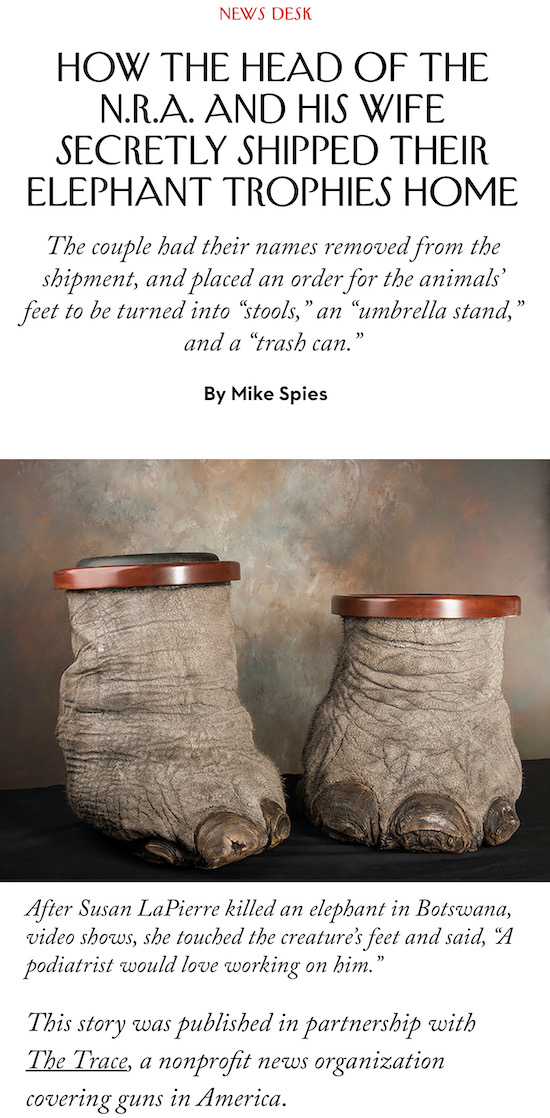
Written by Mike Spies, The New Yorker ran the article 'How the Head of the N.R.A. and His Wife Secretly Shipped Their Elephant Trophies Home' on July 29, 2021. That would be the executive vice-president of the National Rifle Association (NRA) and CEO Wayne LaPierre, and his wife Susan who also sits on the board of the NRA. 

It led on from the aftermath of the leaked footage from April 2021 of Wayne LaPierre's bungled shooting of an elephant in Botswana in 2013. The footage had been carefully kept secret till this year. It was first published by The Trace and The New Yorker.

The LaPierres are back in the news because the NRA's January 2021 motion for bankruptcy was denied by federal judge in May 2021New York Attorney General Letitia James has moved to dissolve the National Rifle Association after an 18-month investigation into its activities of financial misconduct and fraud.

The suit alleges that top NRA executives misused charitable funds for personal gain, awarded contracts to friends and family members, and provided contracts to former employees to ensure loyalty.

Seeking to dissolve the NRA is the most aggressive sanction James could have sought against the not-for-profit organization, which James has jurisdiction over because it is registered in New York. James has a wide range of authorities relating to nonprofits in the state, including the authority to force organizations to cease operations or dissolve. The NRA is all but certain to contest it.

I read this with a grim face. I didn't grow up in a society where the culture is all about guns and the killing of wildlife. I've joined hunts (as a child) in the UK for pheasants and foxes; I've hunted wild boars. But I can't stomach hunting a bigger animal with guns. We've pretty much destroyed theses animals' homes, and I can't bear to think that they have nothing left. I can understand the thrill of a hunt, but I'll never understand why people are addicted to it, or see the need to do it regularly. Is there pride in killing a defenseless animal with guns? 

I certainly don't expect less from the executive vice-president of the National Rifle Association (since 1991) and his wife. They are certainly the faces of it, but they're not the only ones. Like any other cause or campaigns, they'll have allies, and strangers who believe in their beliefs and support what they do. This is how we have factions and cracks within a democratic society that is really ironically, not at all equal or meritocratic. 

The LaPierres felt secrecy was needed, the e-mails show, because of a public uproar over an episode of the hunting show “Under Wild Skies,” in which the host, Tony Makris, had fatally shot an elephant. The N.R.A. sponsored the program, and the couple feared potential blowback if the details of their Botswana hunt became public.

The idea of bringing my hunting trophies home is a tad stomach churning. That is certainly not the case for the LaPierres in 2013, or any time during their lives when they participate in these hunts. They identified a taxidermist to help this project of receiving the shipment and turning the dead meat and flesh into permanent trophies as furniture and handbags. Turning an elephant's foot into stools. That's disgusting. But I dunno if it's as disgusting as me using a leather bag. But I supposed sitting on a dead elephant's foot that you had killed is one level up than what I do or would use.  

Taxidermy work orders containing the LaPierres’ names called for the elephants’ four front feet to be turned into “stools,” an “umbrella stand,” and a “trash can.” At their request, tusks were mounted, skulls were preserved, and the hyena became a rug. The episode represents a rare instance in which the gun group’s embattled chief executive is captured, on paper, unambiguously violating N.R.A. rules; the e-mails show that Susan directed the process while Makris’s company, Under Wild Skies Inc., which received millions of dollars from the N.R.A., picked up the tab.

The ban on big-game hunting has sparked off a ton of discussions, and whole new controversies. You can read it and decide for yourselves. It's all about what humans choose to do, if they respect the sanctity of wildlife, or they feel that without the money of big-game hunters, wildlife habitats will be turned into human habitats. Either way, conservationists wring their hands and find their loyalties divided and sorely tested. 

At this point, my political views have consolidated and settled. We don't get to choose our friends' families. But our friends get that choice, and we get to choose our friends. I cannot imagine being good friends with extreme Republicans (and its equivalent in all countries) who are also advocates for the right to use guns, and the right to hunt. And worse, willing to pay a lot of money to organize big-game hunting trips in third world countries to decimate their wildlife. Even when such a trip is legal and fully-permitted, they don't sit well with me. (This isn't anything like hunting for wild boars.) And of course people who go for those won't care what I think anyway. 

Wednesday, June 23, 2021

Much Ado About Tuna


When I read about Subway being sued in Northern California over their tuna used in their sandwiches in January in The Washington Post, I was like waaaaah. The plaintiffs alleged the 'tuna' is an imitation, and "the ingredient billed as “tuna” for the chain’s sandwiches and wraps contains absolutely no tuna." 

The sandwich chain is no stranger to weird lawsuits and disgruntled customers. They were sued for selling sandwiches that were less than a foot long. Thankfully, sanity prevailed and that lawsuit was thrown out by the US appeals court. Subway is being sued for fraud, intentional misrepresentation, unjust enrichment, among others. The main point of contention here it seems, is the tuna. The plaintiffs claimed that its tuna isn't even fish, but a fabricated ingredient used in place. 👀

Well. I haven't eaten a Subway sandwich for years. Maybe a full decade. In Singapore, I have choices. If I want a sandwich, one from Subway isn't my default or at the top of the list. I would just get a bánh mì or a savory bun of sorts from the nearest bakery. I'm not fond of those tuna buns from the local bakeries though. Those kinda suck. It's a weird mash-mash of sweet bread with savory tuna and bits of onions. It could be any mystery meat, and no one would be none the wiser.  

According to Subway’s nutritional information page on its website, the tuna salad for its sandwiches contains flaked tuna in brine, mayonnaise and an additive to “protect flavor.” A spokeswoman for Subway said the nutritional information is up to date.

Of course Subway has "categorically denied the allegations" and stated that their tuna sandwiches ranked as the best loved on the menu. Subway employees didn't think the tuna was fake, since the meat was already relatively cheap, and there wasn't a point to find replacement tuna to have it sold to customers in the sandwiches. 

Now, there’re further developments and The New York Times also got into dissecting the Subway’s tuna. Titled 'The Big Tuna Sandwich Mystery' written by Julia Carmel published on June 19, 2021. The writer actually bought more than 60-inches worth of Subway's tuna sandwiches, froze them, and sent them to a laboratory, paid $500 to do a PCR test to determine if the contents included one of the five species of tuna. However, the lab results were inconclusive, and no amplifiable tuna DNA was present in the sample. 

Commercial canned tuna. It has been cooked and thoroughly processed. The protein has been completely broken down. Sometimes, I can’t even tell the difference between tuna and chicken. Canned food sort of taste the same. Oof. I'm not fond of tuna. But I still pop by the shops to get a tuna maki rolls to-go, or tuna inari sushi. They're inoffensive and easy to eat. And I absolutely can't tell if it's actually tuna. Hahahaha.

The writer also spoke to people within the industry to discuss if and why would Subway swop out its tuna. Many figured that if there was fraud, it would have happened at the cannery, and not an intentional move on Subway's part. One Peter Horn, the director of the Ending Illegal Fishing Project at the Pew Charitable Trusts puts it across the best. He "agreed that it would be difficult to place blame on Subway if this were the case." The writer highlighted another report's laboratory results as conclusive for tuna DNA, contents of which were procured from three locations in Queens. 

And even as Subway’s prices have risen beyond the days of $5 footlongs, Mr. Horn said the company’s notably cheap sandwiches raise more important questions than the integrity of their tuna.  “We can’t just continue to have a downward pressure on the price,” Mr. Horn said, “because if we all want everything at rock bottom prices, that means something, somewhere is going to be exploited, whether that’s people or the ocean — probably both.” 

Wednesday, June 09, 2021

Clementi Forest

I'm not enthusiastic to join the crowds thronging the Green Corridor or Clementi and Dover forests. I didn't even really feel like hitting the MacRitchie trails or Bukit Timah Reserve. It's less fun when nature reserves are out of bounds to the dog, and I know she would love all the smells. Also, the Singapore weather is too damn hot for me (and the dog's paws) to be doing any major trekking. The humidity just kills me.

I do miss seeing wide expanses of green and blue, and I can trek for miles in mild weather. But in Singapore, I'm a lazy worm. I'm not about to roll out of bed at 5am to roll in mud and perspiration every week. NO THANKS. The views are gorgeous; I'm not sure it's worth it. Hahahaha. We have views too, although they aren't the same. I appreciate what this city offers, but it's really not the same when it's man-made and sanitary. The weather is a giant mood-killer. I just can't. I don't care so much about the bugs or whatever. They bother me, but bugs are everywhere anyway. I'll just spritz bug repellent and hope it works for a bit. 🤷🏻‍♀️

I've taken walks along the unmarked trails of Clementi Forest long before the media picked up on it and long before they did all those IG-shots for it, and long before the crowds whooshed there. That weekday morning, I took the dog for a walk at 7am — just us girls! Wore comfy and sturdy-af Wellies, and off we went. I wasn't going to do the full trail with the dog. We would do a short 2km or so. We would exit near P's house and she was ready to welcome us into her dining room for breakfast, and avail her super practical mud room + bathroom to us. Muahahahah. Started the walk opposite Ngee Ann Polytechnic since I didn't feel like exploring, and this is the path I know. 

I had a walking stick borrowed from the friend because I was a tad scared of monkeys and dunno what nonsense that might attempt to attack Choya. I was well-prepared for mud and had a backpack to carry her through the tougher portions. (She only just recovered from being bitten by a damn monkey.) Her flea and tick meds are up-to-date, but I still sprayed bug repellent (formulated for dogs) over her. This is a smol city dog with delicate paws, unused to the forest terrain, real mud and bugs. LOL Smol dog emerged unscathed, unscratched and she was sooo happy from the morning jaunt and learning all about new smells.

This was the dog's first visit ever, and this was my first visit in over 1.5 years. Wow, the muddy patches have grown; there're to be many more trails trampled out by other people who don't want to do mud crossings, and the forest feels... inhabited. There was also a lot more plastic and paper garbage strewn around. WHAT IS IT WITH HUMANS?! You want to snack, do pack remnants away into your bag and bin it when you exit! SO ANNOYING. Singaporeans really cannot have nice things. 

Tuesday, May 18, 2021

Phytoplankton for Choya

I used to take fish oil capsules, then it became krill oil capsules. It was just one of those things that the parents and grandparents forced me to take, especially when I had so many allergies as a child. Like those spoonfuls of Scott's cod liver oil, which were damn gross. I refused to take it. Pills were a no-no too. The adults soon realized that I very much prefer capsules. 

As an adult, I don't particularly bother about supplements except the basic ones, say, multivitamins and such. I stopped fish oil. Although I was a bit skeptical of bioavailability, some vitamins seem harmless or even necessary. So I continued with them until my ob-gyn took a look at my bloodwork and told me to go off supplements unless it's Vitamin C or probiotics. 

So for Choya, I take the same approach towards supplements — the fewer the better. I most certainly wouldn't give her fish or krill oil. They turn rancid so quickly, and sourcing fish for supplements creates dead zones in the oceans. It's not ocean-friendly. Phytoplankton kept popping up as a 'superfood'. I mulled over phytoplankton for the longest time. Like, for a full year. I was hesitant because I wanted to understand the science behind it, not just subscribe to trends or in support of environmental sustainability. 

When Choya was injured, I immediately considered her post-surgery nutrition. The nature of the injury/wound meant that she would require tons of protein and amino acids to grow new skin and for tissue repair, and reduce overall inflammation. Probiotics would be needed to balance out all the meds, especially the antibiotics. I needed antioxidants and supplements, but I didn't need junk or a truckload of them. That's unhelpful and confusing to her GI tract. Her nutrition should mainly be ingested from her whole foods. But phytoplankton. It's a single-cell plant. I don't know which species it is, but I assume commercial ones grown on land would be common autotrophs. 

I took the plunge and bought a bottle of Phyto Synergy from Adored Beast. It holds 45 servings. If this would hasten the body's healing process, I'd take a chance. Bottled phytoplankton comes in a powder form, in green, with a rich mineral smell of the sea. I love it! Hahaha. I certainly don't expect it to work miracles. Nothing ever happens that way unless the true hand of God is at work. The phytoplankton should work in tandem with fresh and whole foods, meds and the current state of the body's immune system. 

I prayed that the year of balancing her diet would have strengthened her immune system to get her through this injury. Her healing speed is superb. I know dogs are hardy, but I've forgotten exactly how hardy they are. Her appetite, lack of nausea and solid poop tells me that her digestive system is okay. While it took a hard hit from the general anesthesia and antibiotics, it remained stable. The rate of healing in a matter of 10 days tells me that she has been blessed with good genes, and I'm doing something right with her food and the added 'supplements'. I'm sticking to this ratio and I'm not going to muck around with the formula. 

One dinner.
A dog's nutrition is balanced over the week, not in a matter of single meals. 

Friday, March 05, 2021

Popped over to Coney Island


With the cool temperatures dissipating with the end of February, we made the effort to get out to Coney Island before the crazy mosquitoes swarm back. Also, March will see our pace of work pick up, and the call schedules are crazy. Although I’ll be at home churning out work, I’d have a lot less time to take the dog out to play. We went at 5.30pm, just as the heat of the day decreased and there was still light. 

We had so much fun that we forgot about the time and were a tad late. We came out at 7.15pm just before the gate closed, and saw the guard waiting with his motorbike. There were few people coming out late before and after us too. We saw a number of photographers and assistants, and a few couples decked out in wedding gowns and suits in sandals and track shoes.

As the sun set, we went to get dinner just next door at the very convenient Punggol Settlement with all its food offerings. It was a 45-minute drive up here, so we might as well make full use of the effort, and sorted out a super decent spicy-enough meal at Trunk 95. What a fun outing! There're so few green spaces in Singapore. Glad that the rich ecosystem at Coney Island is protected. 

We didn't rent a bike. Well, neither the man and I could ride a bicycle very well. Muahahahah. We only intended to take a short stroll with the dog. She was very happy. We were so tickled to see her reactions to the green. The park would smell different from the rest of the sanitized versions. There's a lot more wildlife in this one. Dog was super excited sniffing around and darting everywhere. There was a gorgeous breeze wafting through, and it was still blessedly cool by Singapore standards. We savored the last of the fabulous weather. Lookin at how dry it had been, the heat would come back with a vengeance after the weekend. 

Wednesday, February 17, 2021

Valentine's Day at Sungei Buloh Wetland Reserve


When M and D suggested visiting Sungei Buloh Wetland Reserve for a morning walk, I was all for it. I hadn't visited since they renovated and added more wooden barricades in 2020. For these few weeks, the weather is favorable for outdoor activities in the mornings, and a breeze still stirs, and it's relatively cool in the shade. Took the dog for a long walk early in the morning and fed her. So she was happy to snooze at home while the man and I took a jaunt up northwest of the island.

We usually either catch the low tide or high tide when we go. Or we turn up at 7am when the park opens. This time, we wanted to catch the high tide that was scheduled to roll in at 11.30am. Decided to park at Kranji Way entrance since that carpark was bigger. Neo Tiew Crescent's small carpark was full and nothing moved. Parking at Kranji Way entrance was easy because when we got there, the morning crowd was leaving, and many carpark lots opened up. 

We wanted an easy stroll and to spot some birds. At 10.30am, the nature reserve wasn't as crowded as I had feared. There was sufficient space for us. Most people kept their distance and kept to their groups, as we did. And thankfully, we didn't have loud people yelling or playing crazy music over speakers.

There were plenty of signs warning visitors about crocodiles. I was tickled by just how many signs were put up. Crocodiles don't get as good PR as otters. I doubt visitors would clamor to see them. But yeah, some people might topple over into the crocodiles' domain, and it's all over for the humans. Well, we didn't see any crocodile. It wouldn't be easy to catch a crocodile unless we get lucky. Or we get a float of them swimming over from the Strait of Johor.

I laughed when a few sites used 'trek' to describe Sungei Buloh's boardwalk and paths. Please, it's such a sanitized walk that you might not even need to wear track shoes if you prefer a pair of sturdy sandals instead. The trails are short and easy. I also didn't put on mozzie repellent. LOL At this time today, Sungei Buloh didn't even have mozzies bothering us. There were more than enough humans to feed off of, and it was too hot for them at the time we were there. Hurhurhur.

Didn't see them cute mudskippers. Saw plenty of mud lobster mounds, but no sign of the critters. No mangrove crabs scuttling around either. They were all hiding. Bah.

Spotted plenty of redshanks and greenshanks, egrets, and a big heron I really wanted to see. Although at that distance, it took me a long time to discern if it was a heron or a milk stork. There were other birds flying around, all of which I couldn't make out or identify. Hahahah. D's gift of the binoculars helped in spotting birds and such. But I couldn't link them with her gift of the book of migratory birds at the wetland reserve (the 2nd edition published by the National Parks Board). Obviously I need more practice at bird-spotting.

Since this is a migratory stop for many birds, the water levels three brackish ponds in the wetland reserve are managed between July to April so that it acts as a high tide roost site for shore birds. These three ponds are conducive for the birds since they're not left submerged or exposed for more than four consecutive days. There're five other ponds in the reserve that are left to natural tidal pulls, rains and sun.

The wonderful news is, the government is taking steps to protect this area. They'll be creating a Sungei Buloh Nature Park Network. The current 202-hectare Sungei Buloh Wetland Reserve will be joined to the Kranji Marshes, the Mandai Mangrove and Mudflat Nature Park, and the Lim Chu Kang Nature Park (where Cashin House is, and will be restored as a visitor center and exhibition space) by the first quarter of 2022. This brings us to a new area total of 400 hectares of gorgeous nature to experience. I'm excited about it!

Monday, August 17, 2020

'Eating Chilli Crab in the Anthropocene'


Recently published 'Eating Chilli Crab in the Anthropocene' is an anthology of 12 stories written by 13 young authors. It's put together and edited by Dr Matthew Schneider-Mayerson. Each of the stories use an impressive number of endnotes to explain the various references to texts and citations. The first had the most- 89. The second had 71. Heh.

I felt like I was reading someone's thesis or final term essays. Essentially, these are, isn't it? They put it plainly across to readers what climate change is, and how our life affects the climate, and climate change affects us. They didn't hold back on the analysis or references to back up their claims or their perspectives, patiently explaining, through personal anecdotes, historical records and empirical evidence.

While an very engaging read, I couldn’t finish the book in one sitting. I read one story, and pondered, then I began on the next story. In an interview with TODAY published on 25 May, 2020, editor Dr Matthew Schneider-Mayerson explained his rationale for the title of the collection, and how chilli crabs bring home the pressing global environmental issues.

Explaining why the book only includes voices from authors born between 1993 and 1998, Dr Schneider-Mayerson said it is not about omitting the voices of older generations.

Rather, it is about “including and centring” the voices of those who will be most affected by climate change.

“We’re accustomed to thinking of elders as teachers and young people as students, but in this time of a global movement spearheaded by a Swedish teenager (environmental activist Greta Thunberg), familiar roles have been reversed,” he said.

“The sad truth is that those of us in our 40s, 50s, 60s and 70s failed to stop climate change when we had the chance to do so.

“If we let that sink in, it’s a call to humility, to accept that the solutions to our current crisis might require new ideas and new voices.”  

The first story in the book is the eponymous essay by Neo Xiaoyun. She talked about our Singaporean obsession with food, what we consider as 'national dishes', and of course, the mud crabs that are used to cook our famous Singaporean chilli crabs. She linked it back to our ecosystem, the mangroves, the subsequent urbanization that decimated the local population of crabs. I'm not sure if she will convince people to eat fewer crabs though. What will make people cut back on crabs would be shellfish allergies and cholesterol levels. LOL

Too often, we fail to respect what environmental educator David Orr has called the "older processes of evolution and integrity and balances of natural systems." In this context, a conversation restricted to more or less ethical means of killing feels inadequate. The broader question, which pits beloved though often surprisingly recently-developed cultural practices against environmental sustainability—by which I mean the long-term habitability of this planet—is the following: What might a transition to a low seafood and meat consumption lifestyle, which many scientists suggest is necessary, look like? How can this occur in a place that is currently defined by its carnivorous food culture? The fact that answers are unlikely to be forthcoming is indicative of the depth of the challenge of shifting cultural norms into alignment with real sustainability. 

The stories touched on displaced indigenous islanders, otters and the Singapore public's love affair with them (I don’t find them cute and I hate the hype and how they’ve been held up as conservation symbols when we decimate Bukit Brown), tigers, land reclamation and the issue of importing sand (major political thorn that has been swept under and hushed up), monkeys, Javan mynah birds (an 'invasive species' that has rooted totally), oil and fossil fuels somehow linked to 1950s Malay horror films focusing on the myth of the orang minyak, the displacement of culture and history, Changi Airport and carbon emissions versus our guilt of travel, flying, and finally, the way forward in this climate crisis that is still being denied by certain governments.

The story that stayed with me most is Fu Xiyao’s ‘Dumpster Diving in Semakau: Retrieving Indigenous Histories from Singapore’s Waste Island’. Compared to other countries' landfills which are "open dumping side and hazardous waste leaks into nearby water systems and waste avalanches endanger scavengers, Semakau Landfill is considered a model par excellence of waste management." Once known as Pulau Seking and Pulau Semakau, the islands were joined in 1999 with a man-made 7-km seawall of rock and sand, and became Semakau Landfill. According to the National Environment Agency (NEA), Semakau is expected to be filled in 2035. We're only 21 years in. This means that the landfill's projected life span has shortened from 46 years to 36. 

In this way, Semakau Landfill is a "tragic solution," defined by ethicist Jeffrey Chan as a solution that alleviates an existing problem but creates a new, equally problematic predicament. It demonstrates the paradox of waste management within a developmental capitalist state. The construction of Semakau, Singapore's omnipresent advertising and the acceleration of wasteful consumption all boost Singapore's GDP. As long as development is measured by consumption and GDP, we are trapped in a "take-make-waste" treadmill that will require building one Semakau after another, forever. The construction of Semakau Landfill in 1994 prepared a tremendous graveyard for the ashes of decades of economic growth, but it also created a path dependency for Singapore's throwaway consumer culture and fossil-fuel-driven economy. Landfills put the costs of consumption and development out of sight, out of mind, only to produce future crises of overflowing waste and postpone indefinitely a meaningful response to the destruction of land, oceans and communities. 


Monday, April 06, 2020

'Tiger King: Murder, Mayhem and Madness'

I was drawn to watch 'Tiger King: Murder, Mayhem and Madness' on Netflix. It was extremely informative, and repulsive. At the end of the seven episodes, I felt sickened. Directors by Eric Goode and Rebecca Chaiklin spent five years in this world among controversial figures (dealers and owners) keeping big cats in cages across America, and one big-cat owner's ego loomed large in the series —Joseph Maldonado-Passage — the notorious Joe Exotic who owned a dodgy roadside zoo in Oklahoma.

The docuseries played up his feud with nemesis Carole Baskin. She owns Big Cat Rescue — a big cat sanctuary owner who is determined to put him out of business. The sanctuary sells tickets to visitors, and has great marketing and branding. Carole and her third and current husband Howard Baskin aren't pleased with how this docuseries has turned out. Her second husband Jack Donald-Lewis has been missing since August 1997 without any leads to his fate. However, the popularity of this docuseries has prompted Hillsborough County's Sheriff's Office to re-open the case. In an interview with the Esquire published on March 21, 2020, the directors shared what inspired them to film the show and some of their thoughts. They said,

What is certain is that while concern for the welfare of animals might inspire Tiger King’s subjects, the people procuring these wild creatures have a complex relationship to their animals. 
“They use these cats as a status symbol, to carve [themselves] out as being special,” says Goode. 
“Their identities were completely tied up in their cats, whether it was being the ‘Mother Teresa of Cats,’ or the ‘Tiger King,’” Chaiklin adds.


Before watching this documentary, I never even knew who Joe Exotic is. He's currently in a federal prison in Texas. He has been sentenced for an attempted murder-for-hire conspiracy and animal cruelty charges, but he's appealing against the conviction. I was curious enough to read more into Joe Exotic's accused crimes, his treatment of animals, and his famous feud with Carole Baskin, and of course, the mysterious disappearance of her second husband. So many juicy assumptions and theories.

I'm not a fan of zoos or circuses with live animals. I was that strange kid who didn't like visiting any zoo or aquariums, and made my objection known, loudly. I was certainly not interested in catching any circuses anywhere. And I most certainly don't hanker for any visits to a Sea World, Ocean World and such. Marine mammals and sea creatures belong in the wild, not in captivity.

I really like small cats and big cats. Cubs and kittens are always cute. But they don't belong in cages. They should remain in the wild, and not be used to satisfy vain humans and their need to dominate. No matter what, they shouldn't 'broken' to do the humans' bidding. Not in this time.

Wired's Kate Knibbs sums it up really well in her essay published on March 31, 2020, ''Tiger King' is Cruel and Appalling—Why Are We All Watching It?' It is a fairly repulsive show, and I watched it. There's this thing about hunting, then there's this thing about trophies and owning live animals. The songs are hilarious and sad at the same time. The docuseries reminded me that America still has a healthy trade in the underbelly of exotic pet ownership. Drugs, meth, suicide, and ego. Guns rule too. I can understand why PETA does what it does in America. Although violence begets violence.

As the documentary progresses, Joe’s story curdles from that of a crude but essentially well-meaning local eccentric into that of someone both dangerous and cruel. The bulk of the narrative is devoted to unpacking Joe’s prolonged feud with a daffy Floridian millionaire named Carole Baskin. Like Joe, Carole keeps big cats and other wild animals in cages and charges visitors to see them while paying her support staff meager wages. Unlike Joe, who openly breeds his cats for money, Carole markets her operation as an animal sanctuary—Big Cat Rescue—and has pledged to rid the country of breeding, growing a devoted online fanbase. Her Instagram’s huge. 
Although the animals they keep have similarly grim living conditions, the rivals do not. Carole is a wealthy faux-hippie; Joe is a cash-strapped raw nerve. Carole accuses Joe of animal abuse; Joe accuses Carole of killing her late husband and feeding him to her tigers (a claim she denies). Carole’s weapon is her fat tiger-print pocketbook, as she can stay in legal battles long enough to ruin Joe financially. Joe’s weapons are more varied and far scarier. Sometimes his plots against Carole are goofy, like when he hires a look-alike to portray her in a homemade music video. But more frequently, they are cause for real alarm, as he fantasizes out loud about killing her again and again. Joe does not succeed in killing Carole. But he does claw his own life into tatters as he pursues her, as well as the lives of the people who are loyal to him and the animals in his care.

Monday, January 20, 2020

‘A Rising Tide Floods All Houses’


I have been reading really heavy books for work. None of which are pleasurable to think about, much less have them linger in my head after. The topics are depressing. These books tend to make me retreat into a shell in order not to be affected by mild dispiritedness or sink into a blue funk.

When I read for pleasure, genres preferred are always fantasy and magic, horror and the supernatural, graphic novels of more fantasy, and silly articles. The many newspaper and magazine provide information and current happenings that are often not as heavy as work reads, and they supplement it. Came across a painfully relevant old article. I didn’t know whether to laugh or cry at Ginny Hogan’s ‘Idioms Updated for Climate Change’ published in The New Yorker on January 21, 2019. Yes. 2019. Last January... which is still painfully relevant this January, and likely for many more January-ies.

• Can we please address the elephant in the room? Why has this elephant been displaced from Africa? It doesn’t belong in New York City.

I thought I wouldn’t live to see this world suffer the consequences of the Holocene extinction, or simply, the sixth mass extinction. But it’s happening fast and brutal. It seems as though this world is dying. Devastating news ring out across the world. Wildfires, war, extreme weather events, epidemics, viruses, and everything horrible is upon Earth. Climate change is a big word, but surely, we can see that the natural world is telling us that all is not right. We need to scale back on how much resources we've leeched from the natural world, and understand that we're not giving it enough time to replenish ad rejuvenate.

I’d love to keep my head stuck in the ground, and enjoy the current safe shelter that living in Singapore provides. But that’s not possible. I can't think that it doesn't affect me and go on with my life of relative ease and privilege. The least I could do, is to consume consciously and responsibly. I can't preach about sustainable living till I get back to basics and live in a forest, suffer some sort of food poisoning, don't fly and don't travel far in order to leave minimal carbon footprints. On that note,  if the human population dramatically decrease, our scientists and engineers could trot out commercially viable sustainable spheres for humans to live in, then this world could exist in a different form.

• It’s not rocket science. You know, rocket science? The only type of science that matters anymore because we need to find a new planet to live on? 
• Let’s cross that bridge when we come to it, as we escape this raging fire and sprint for dear life toward the rocket ship.